


Types of Private Jets: A Complete Guide by Category
Private jets fall into nine broad categories: turboprops, very light jets, light jets, super light jets, midsize jets, super mid-size jets, heavy jets, ultra-long-range jets, and VIP airliners (bizliners). The category that fits a trip depends on three things: how many passengers are flying, how far the route is, and which airports need to be reached.
Very light jets and turboprops are built for short regional hops and smaller airports. Light and super light jets bridge short regional trips with a bit more cabin and cargo room. Midsize and super mid-size jets offer a cost-effective balance of comfort and range on regional and transcontinental trips. Heavy jets and ultra-long-range jets cover intercontinental missions nonstop. VIP airliners carry large delegations in airliner-sized cabins.
BBAC does not operate a fixed fleet. For every private jet charter request, our team sources the aircraft that fits the mission from a global network of operators, matching passenger count, range, and airport requirements to the specific trip rather than to what happens to be available in-house. That is also why the comparison below is a starting point, not a final answer. The fastest way to confirm which category and aircraft fits your route is to get in touch with our team — we respond with options in under 15 minutes.
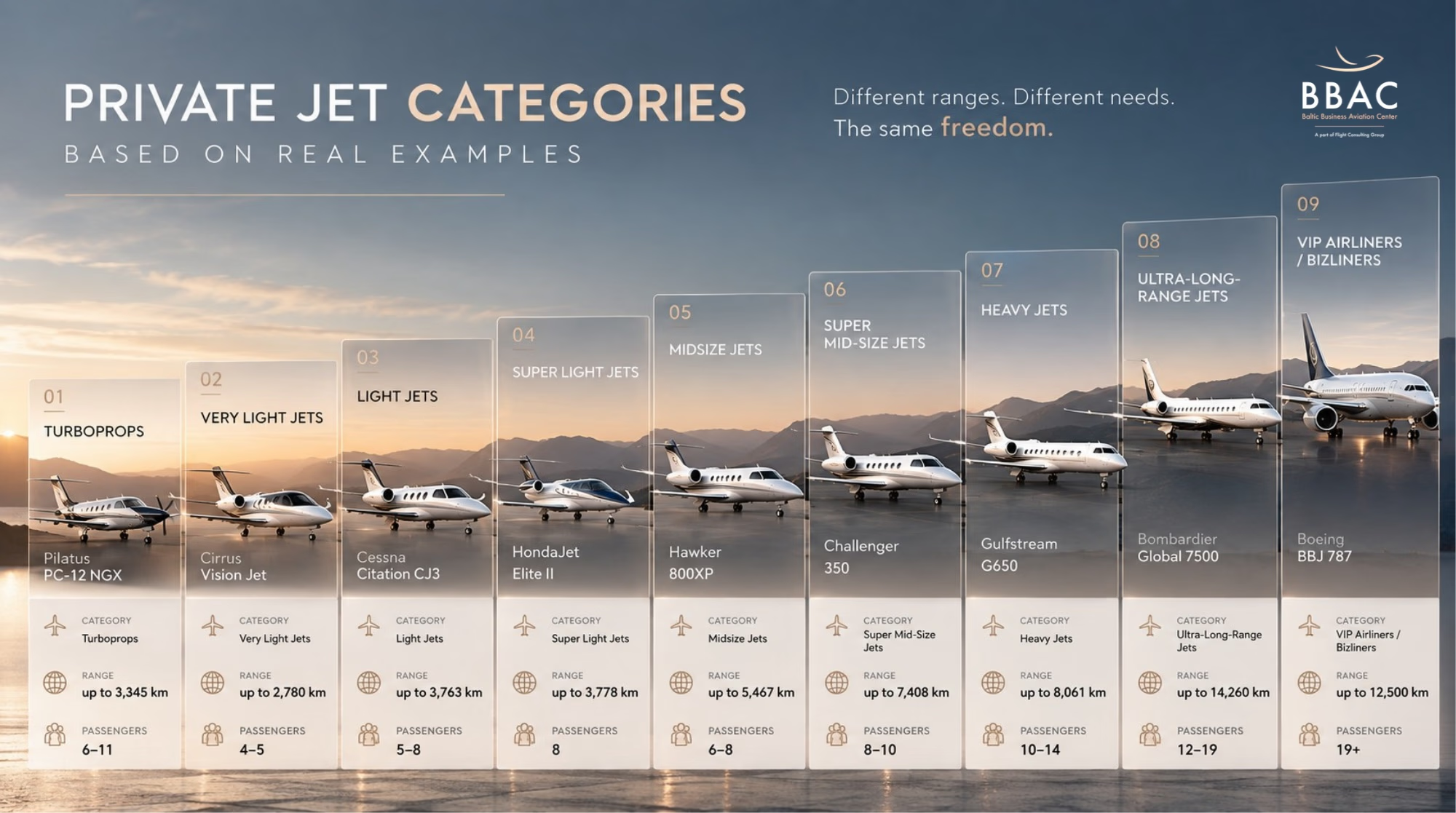
Private Jet Categories at a Glance
The table below summarises the main categories. For a side-by-side comparison of specific aircraft, use the jet comparator.
Turboprops — 6 to 11 passengers, up to 3,345 km. Best for short regional trips and small or unpaved airstrips. Example aircraft: Beechcraft King Air 350, Pilatus PC-12 Pro, Cessna Grand Caravan.
Very Light Jets — 4 to 5 passengers, up to 2,780 km. Best for quick day trips and small regional airports. Example aircraft: Cessna Citation Mustang, Embraer Phenom 100, HondaJet.
Light Jets — 5 to 8 passengers, up to 3,763 km. Best for regional business travel and tight airfields. Example aircraft: Learjet 45, Cessna Citation CJ3/CJ4, Hawker 400XP.
Super Light Jets — 8 passengers, up to 3,778 km. Best for regional trips needing more cabin and cargo space than a standard light jet. Example aircraft: Bombardier Learjet 75, Pilatus PC-24, Embraer Phenom 300, Cessna Citation XLS+.
Midsize Jets — 6 to 8 passengers, up to 5,467 km. Best for domestic and near-regional trips with a full-height cabin. Example aircraft: Gulfstream G150, Hawker 800XP/900XP, Bombardier Learjet 60/60XR.
Super Mid-Size Jets — 8 to 10 passengers, up to 7,408 km. Best for transcontinental trips with a full galley and enclosed lavatory. Example aircraft: Bombardier Challenger 300, Challenger 350, Cessna Citation X, Citation Latitude.
Heavy Jets — 10 to 14 passengers, up to 8,061 km. Best for transatlantic and long transcontinental trips with larger groups. Example aircraft: Bombardier Challenger 605, Gulfstream G450, Dassault Falcon 900.
Ultra-Long-Range Jets — 12 to 19 passengers, up to 14,260 km (roughly 7,700 nautical miles). Best for nonstop intercontinental missions. Example aircraft: Bombardier Global 6000, Global 7500, Gulfstream G650, Dassault Falcon 7X.
VIP Airliners / Bizliners — 19+ passengers, up to 12,500 km. Best for large delegations, heads of state, full-cabin conferences. Example aircraft: Airbus Corporate Jet (ACJ) 319, Boeing Business Jet (BBJ), Embraer Lineage 1000.
See the full BBAC fleet by category.
"Out of our last 36 flights, the aircraft choices were divided into very different categories: 18 flights were performed on heavy / ULR jets, 4 on midsize jets, and the rest on light and super light aircraft. This shows there is no single winning aircraft category — the real winner is the aircraft correctly matched to the client's needs and the mission." — Viktorija Gorodnicka, Managing Director, BBAC
How Private Jets Are Classified
Manufacturers and operators group private jets by a mix of practical factors rather than size alone:
Passenger capacity — the number of seats a cabin carries comfortably, not the technical maximum.
Flight range — the maximum distance without refuelling, usually quoted in hours of flight time as well as kilometres or nautical miles. Range determines whether a trip needs a technical stop.
Cabin size — height, width, and volume. Height decides whether passengers can stand; width affects seating and movement on longer flights.
Luggage capacity — the volume of the baggage compartment, often overlooked when a category is chosen on range alone.
Runway requirements — lighter aircraft can use short runways and smaller airports; heavier aircraft need longer, paved runways.
Onboard amenities — lavatory type, galley, WiFi, entertainment, and on the largest aircraft, bedrooms with lie-flat beds, showers, and conference areas.
Crew requirements — single- or dual-pilot certification, and whether a flight attendant is standard.
Charter cost level — hourly rates generally rise with category, though not strictly linearly. A super mid-size jet flying a long route nonstop can cost less overall than two legs on a smaller aircraft with a fuel stop.
Private Jet Categories Explained
Turboprops. Propeller-driven aircraft, grouped here because they're chartered for the same short-haul missions as jets. Suited to routes under roughly 3,345 km and to smaller airports with short or unpaved runways. Lower hourly cost than light jets; cabins are compact with limited standing room.
"You want to land in St Tropez? Well, let's get you a Pilatus PC-12, which can operate there without an issue." — Viktorija Gorodnicka
Very Light Jets (VLJ). The smallest category, typically seating 4 to 5. Several models are certified for single-pilot operation, keeping costs down. Suited to trips under about 2,780 km — regional business travel, weekend trips, or short connecting legs. Limited luggage space, so packing light matters.
Light Jets. Seat 5 to 8 with a modestly larger cabin and hold than VLJs. Range up to roughly 3,763 km, covering most regional routes without a fuel stop, and still able to use shorter runways. A common choice for small teams travelling for a single meeting or event.
"You want a cost-efficient flight within Europe, covering 3 countries in 4 to 5 days? A light jet can be a great option, as long as the luggage is packed just as efficiently as the trip is planned." — Viktorija Gorodnicka

Super Light Jets. Seat around 8 passengers, sitting between light and midsize jets on cabin and cargo space. Range up to roughly 3,778 km — similar reach to a light jet, with more room onboard. A frequent choice when a light jet's cabin feels tight for the group or the luggage.
Midsize Jets. Carry 6 to 8 passengers in a cabin tall enough to stand in — a real comfort step up from light and super light jets. Range up to about 5,467 km. Typically include an enclosed lavatory, a small galley, and WiFi on most current-generation aircraft.
"You need a 4 to 5 hour nonstop flight with six passengers for a business meeting? A Hawker 800XP can do the job well: good range, comfortable cabin, but limited luggage space." — Viktorija Gorodnicka
Super Mid-Size Jets. Seat 8 to 10 with a wider cabin and higher cruising speed than midsize jets. Range up to roughly 7,408 km, covering most transcontinental routes nonstop, with a full galley and enclosed lavatory as standard.
Heavy Jets. Carry 10 to 14 passengers in a stand-up cabin wide enough for conference-style seating. Range up to about 8,061 km — transatlantic and most long transcontinental trips nonstop — with a full galley and often a crew rest area.
Ultra-Long-Range Jets. Seat 12 to 19 passengers, built for nonstop intercontinental missions with range up to roughly 14,260 km / 7,700 nautical miles. Cabins typically include lie-flat beds or a dedicated bedroom, a full galley, and an enclosed lavatory with shower on some models. Hourly rates are the highest of the standard business jet categories.
"You want to fly transatlantic without the hassle of fuel stops, sleep comfortably in a proper bed, and arrive rested? A ULR is the way to go." — Viktorija Gorodnicka
VIP Airliners / Bizliners. Converted narrow-body or regional airliners, typically configured for 19-plus passengers, with range up to roughly 12,500 km depending on the conversion. Cabins can include private suites, a conference area, and crew quarters. Used for large delegations, government and diplomatic travel, and groups moving together with full privacy. The most expensive category to charter.
Common Mistakes When Choosing a Private Jet
Choosing a category on range or passenger count alone is the most common source of a mismatched booking.
"Listening to the client and understanding everything behind the request is essential. The route is only one part of it — passenger numbers, luggage, preferred airports, timing, comfort expectations, budget, even weather can change which aircraft makes sense. If a super light jet can't perform a European flight at full capacity without a fuel stop, it's our responsibility to make that clear from the beginning. No hidden details, no unexpected fuel stops or additional costs. Business aviation should not come with low-cost airline surprises." — Viktorija Gorodnicka
Case 1 — Booking on range, missing the runway. A family office assistant needed a small group flown to a private estate near a short regional airstrip. Route length pointed to a super mid-size jet, but it couldn't use that runway. Our team flagged the mismatch during the initial quote and sourced a light jet with the range and runway performance the trip needed.
Case 2 — Paying for capacity that isn't needed. A corporate travel manager defaulted to a heavy jet for a two-person executive trip, assuming size equals reliability. A light jet covered the same route with the same on-time performance at a lower hourly rate.
Case 3 — Overlooking luggage and equipment. An event producer's crew travelling with camera and lighting equipment fit a midsize jet on passenger count, but not on cargo. A medical charter faced a similar mismatch: a stretcher configuration doesn't fit every super mid-size or heavy cabin. In both cases, BBAC checked equipment and cabin layout against the aircraft before confirming the booking.
Case 4 — A direct route that depended on the runway, not just the aircraft.
"We had a flight request from London to Seoul, with the requirement to fly this route directly, with no fuel stop, on one of our ULR options. The passengers' preferred airport was Luton, but if the runway there wasn't dry on departure, the aircraft might not take on enough fuel to comfortably guarantee a direct flight. So we changed the departure airport to Stansted; the longer runway gave much better conditions for taking on the required fuel. From there, the operator's OCC and OPS departments confirmed the calculations, flight and fuel planning, and final price — only then did the offer reach the client." — Viktorija Gorodnicka
In every case, the fix was the same: matching the aircraft to the full list of trip requirements, not just range and seat count, before confirming. That review is part of every quote our team prepares.
"Finding the jet is not about requesting 20 options on Avinode and sending them through, but about finding the aircraft that can perform the client's flight the way they actually expect it to." — Viktorija Gorodnicka

FAQ
How many types of private jets are there? Most classifications recognise eight to nine categories: turboprops, very light jets, light jets, super light jets, midsize jets, super mid-size jets, heavy jets, ultra-long-range jets, and VIP airliners. Some sources merge super light jets into the light jet category or treat turboprops as a separate group outside the jet categories, which is why totals vary between sources.
What is the most popular type of private jet? Midsize and super mid-size jets are the most widely chartered overall, balancing range, cabin comfort, and hourly cost for most business and leisure routes.
What is the difference between a private jet and a business jet? None — they describe the same aircraft, used privately rather than for scheduled commercial airline service. Bizliner or VIP airliner refers specifically to the largest category, converted from commercial airliners.
Which private jet type is best for short flights? Very light jets and light jets, for their lower hourly cost and ability to use smaller airports closer to the actual origin and destination.
Which private jet type is best for long-haul flights? Ultra-long-range jets are built for nonstop intercontinental missions; heavy jets can also cover many long-haul routes nonstop depending on distance.
Do all private jets have bathrooms? Most midsize jets and larger have an enclosed lavatory as standard. Very light jets and some light jets have only a private or emergency lavatory — worth checking against the specific route and group before booking.
Can private jets land at small airports? Yes. Turboprops, very light jets, and light jets are suited to shorter runways and smaller regional or private airports that larger aircraft can't use.
What type of private jet should I charter? It depends on passenger count, route distance, and the airports at both ends of the trip. Get in touch with our team and we'll confirm suitable categories and specific aircraft, typically within 15 minutes.

Autumn Calendar: Yachts, Racing and Art
Monaco Yacht Show, Goodwood Revival, Frieze London and Art Basel — how Europe's autumn calendar connects by private jet charter.

How much does a private jet charter actually cost?
Hourly rates, hidden fees, repositioning, taxes — the honest cost breakdown for chartering a private jet from Europe in 2026.
Get an indicative quote in under 15 minutes
Full itinerary, aircraft options, transparent pricing.