

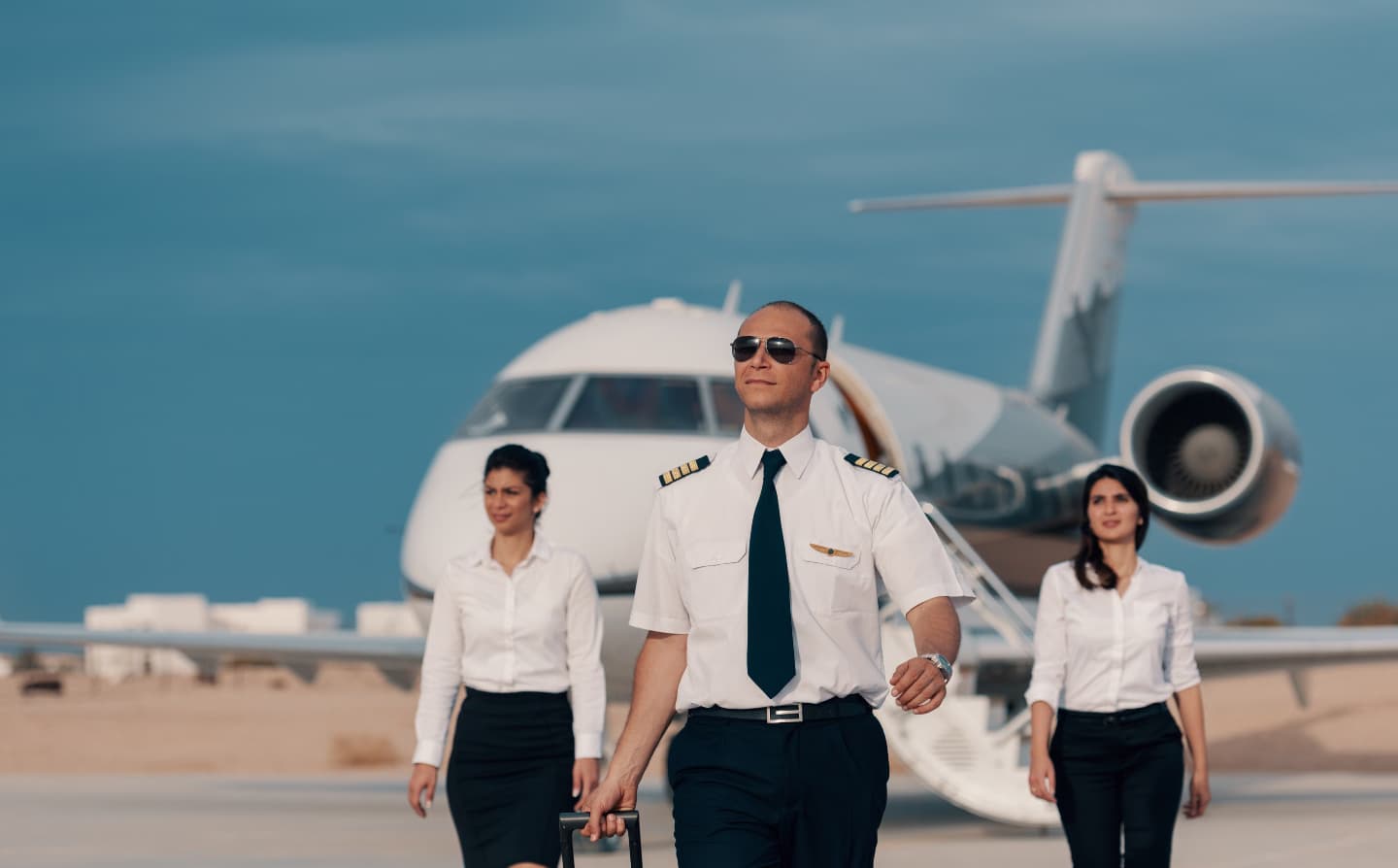
Business Aviation Dictionary: 63 Terms Worth Knowing Before You Fly Private
Business aviation has its own language, and most of it is never explained to the passenger. This dictionary collects the 63 terms our clients ask about most often, from the words you will see in a charter quote to the codes pilots use on the radio. Each definition is short enough to read in a few seconds and is followed by a note on what the term means for your flight.
The dictionary grows from our Business Aviation Dictionary series on Instagram @bbac.aero, where we explain one term at a time. Here you will find the full collection in one place, grouped by the stage of a trip where you are most likely to hear each word.
"Most misunderstandings in private aviation start with a single word. A client reads 'empty leg' and expects a flexible flight at a lower price, or sees positioning time in a quote and thinks it is a hidden fee. When we explain the terms at the start, the conversation about the trip becomes faster and more honest for both sides."
— Viktorija Gorodnicka, Managing Director, BBAC
Booking and pricing
These are the words you will meet in a charter request, a quote or a contract, before the aircraft has even been chosen.
Private jet charter
['praɪvət dʒɛt 'ʧɑːtə]
A private jet charter is the hire of a whole aircraft, with its crew, for a trip you define: the route, the date, the departure time and the passengers. You pay for the aircraft and not for individual seats, so the price stays the same whether you fly alone or with a full cabin, apart from per-passenger airport and handling fees that some airports charge.
One-way charter
[wʌn weɪ 'ʧɑːtə]
A one-way charter is a single flight from A to B with no booked return. It often costs more than half of a round trip, because the aircraft usually has to fly back to its base without passengers, and that return is included in the price unless another client books it.
Empty leg
['ɛmpti lɛɡ]
An empty leg is a flight with no passengers, when the aircraft repositions to its base or to its next booking. Because the aircraft is flying either way, the seats on that flight can be sold at a lower price, but the route and the departure time are already fixed and cannot be changed. You can see the current offers on our Empty Legs page and switch on notifications with the bell icon.
"An empty leg is a good offer when your plans already match its route and date, and it works very well for spontaneous trips. Some clients see a very good price on a route they had not planned and decide to fly there for a few days. At the same time, we advise clients not to build an important trip around one, because the flight depends on the original booking: if that booking changes, the empty leg can move or disappear."
— Viktorija Gorodnicka, Managing Director, BBAC
Positioning flight
[pə'zɪʃənɪŋ flaɪt]
A positioning flight takes an aircraft from where it is parked to the airport where your trip begins. If the nearest suitable aircraft is in another city, the positioning time usually appears in your quote, which is why the same route can cost very different amounts depending on where available aircraft are on that day.
Ferry flight
['fɛri flaɪt]
A ferry flight is any flight made without paying passengers, for example to deliver a new aircraft, to take it to maintenance or to return it to base. Every empty leg is a ferry flight, but not every ferry flight can be sold, because some are made for technical reasons only.
Jet card
[dʒɛt kɑːd]
A jet card is a prepaid package of flight hours with one provider, usually at fixed hourly rates and with guaranteed availability on a set number of days. It suits people who fly often and predictably. Ad hoc charter, where each trip is priced separately, gives more freedom in the choice of aircraft and does not require money to be paid in advance.
Floating fleet
['fləʊtɪŋ fliːt]
A floating fleet is a model in which aircraft are not tied to a home base and move from one client trip to the next. Floating fleets reduce the number of empty positioning flights, which is one reason one-way prices can be lower with some providers.
Aircraft operator
['eəkrɑːft 'ɒpəreɪtə]
The aircraft operator is the company that holds legal responsibility for the flight: it employs the crew, maintains the aircraft and follows the safety rules. The operator is often not the owner of the aircraft, and it is not always the company you booked with. BBAC sources aircraft from certified operators worldwide and manages the trip from request to arrival.
AOC (Air Operator Certificate)
[eɪ əʊ siː]
An AOC is the licence that allows a company to carry passengers or cargo for payment. It is issued by the national aviation authority, and inside the European Union it follows EASA rules. Before any charter is confirmed, the operator's AOC should be valid and should cover the aircraft type and the type of operation.
Wet lease (ACMI)
[wɛt liːs]
A wet lease is the rental of an aircraft together with its crew, maintenance and insurance, which is why it is also called ACMI. Airlines use wet leases to cover peak seasons or to replace an aircraft that is out of service, and sports teams and tour operators use them for long series of flights.
Dry lease
[draɪ liːs]
A dry lease is the rental of an aircraft without crew, so the company that takes the aircraft must provide its own pilots, maintenance and insurance. Dry leases are a tool for airlines and operators, not for passengers.
Cabotage
['kæbətɑːʒ]
Cabotage means carrying passengers between two airports in the same country with an aircraft registered in another country. Many countries restrict it to protect their own operators, which is why a flight between two cities in one country sometimes requires an aircraft registered there, even when a foreign aircraft is closer.
Tail number (registration)
[teɪl 'nʌmbə]
The tail number is the registration painted on the aircraft, and its first letters show the country of registration. Latvian aircraft start with YL, British with G, German with D and American with N, while Malta (9H), the Isle of Man (M) and San Marino (T7) are popular registers for business jets. The registration is how an aircraft is identified in every flight plan and permit.
At the airport
On a private flight you spend minutes at the airport instead of hours, and these are the words that describe where those minutes go.
FBO (Fixed-Base Operator)
[ɛf biː əʊ]
An FBO is a private terminal and service centre for business aviation at an airport. It handles passengers, crew and aircraft: lounge, security and passport control, baggage, fuel, catering and parking. The name comes from the early days of American aviation, when a "fixed base" operator had a permanent place at an airfield, unlike pilots who travelled from field to field.
GAT (General Aviation Terminal)
[dʒiː eɪ tiː]
A GAT is a separate terminal for private and business flights, and at many airports the word is used for the same building as the FBO. Passing through a GAT usually takes 10 to 15 minutes, because there are no queues at security or passport control.
Airside and landside
['eəsaɪd ənd 'lændsaɪd]
Landside is the part of the airport open to the public, and airside is everything after security and passport control, including the aircraft parking area. At many FBOs a car can be allowed to drive airside directly to the aircraft, which requires a permit arranged in advance.
Apron (ramp)
['eɪprən]
The apron is the area where aircraft park, load and refuel, and in American English it is called the ramp. Business jets are usually parked on a separate apron close to the FBO, so passengers walk only a few metres to the aircraft.
Airport slot
['eəpɔːt slɒt]
A slot is permission to take off or land at a specific airport at a specific time. Busy airports such as London City, Nice or Geneva in winter limit the number of movements per hour, and on peak days the departure time is often set by the available slot.
"On a flight to a busy airport, finding the aircraft is rarely the difficult part. The slot and the permits decide when you can actually depart, and on peak days at airports such as Nice or Geneva they matter as much as the aircraft itself. Arranging them is part of what our team does for every trip, so the client sees only the departure time."
— Viktorija Gorodnicka, Managing Director, BBAC
Landing permit
['lændɪŋ 'pɜːmɪt]
A landing permit is official approval from a country's authorities for a foreign aircraft to land there. Inside the European Union most charter flights by EU operators do not need one, while many destinations in the Middle East, Africa and Asia do, and it can take from one to several working days to obtain.
Overflight permit
['əʊvəflaɪt 'pɜːmɪt]
An overflight permit is approval to fly through a country's airspace without landing. Some routes cross several countries that each require their own permit, so the route on the flight plan is not always the shortest line on the map.
Ground handling
[ɡraʊnd 'hændlɪŋ]
Ground handling covers every service an aircraft and its passengers receive on the ground: marshalling the aircraft to its parking place, baggage, fuel, cleaning, catering, water and toilet service, and passenger assistance. Handling fees are part of every charter price and differ greatly from one airport to another.
De-icing
[diː 'aɪsɪŋ]
De-icing is the removal of ice, frost and snow from an aircraft before take-off, usually with heated glycol fluid. The orange fluid you see in winter (Type I) removes ice, while the green fluid (Type IV) protects the wings from new ice for a limited time. In winter, de-icing can add 15 to 30 minutes to a departure and a noticeable amount to the bill.
Chocks
[ʧɒks]
Chocks are the wedges placed in front of and behind the wheels to keep a parked aircraft from moving. "Chocks off" is the moment the aircraft starts to move from its parking place, and "chocks on" is the moment it stops at the destination.
Block time
[blɒk taɪm]
Block time is the time from chocks off at departure to chocks on at arrival, including taxiing. It is longer than flight time, which counts only from take-off to landing, and charter prices are most often calculated on block time.
Wheels up
[wiːlz ʌp]
Wheels up is the moment the aircraft leaves the runway. In private aviation the term is also used for the planned departure time, so "wheels up at 9:00" means the aircraft should be in the air at 9:00, and passengers should arrive at the FBO around 20 to 30 minutes earlier.
Pushback
['pʊʃbæk]
Pushback is the procedure in which a tug pushes an aircraft backwards out of its parking place, because at most airports jets do not reverse under their own power. Many business jets park so they can taxi out forwards, so a pushback is not always needed.
Aircraft
The size of the aircraft decides how many people fly, how far they can go without a stop and how much luggage comes with them. For a side-by-side view of real models, use our jet comparator or read the full guide to types of private jets.
Very light jet (VLJ)
['vɛri laɪt dʒɛt]
A very light jet carries 2 to 4 passengers on flights of up to 2 to 3 hours. It is the most economical jet for short trips between nearby cities, when speed matters more than cabin space.
Light jet
[laɪt dʒɛt]
A light jet carries 6 to 8 passengers on flights of up to 3 to 4 hours, which covers most routes inside Europe. Most light jets have a small toilet compartment and limited luggage space, so luggage should be agreed before booking.
Midsize jet
['mɪdsaɪz dʒɛt]
A midsize jet carries 7 to 9 passengers on flights of up to 5 hours, with a taller cabin and a full toilet compartment. It is a common choice for flights such as London to the Canary Islands.
Super midsize jet
['suːpə 'mɪdsaɪz dʒɛt]
A super midsize jet carries 8 to 10 passengers on flights of up to 7 hours, and most passengers can stand upright in the cabin. It is the smallest category that can cross the Atlantic without a fuel stop on many routes.
Heavy jet
['hɛvi dʒɛt]
A heavy jet carries 10 to 16 passengers on flights of up to 10 to 12 hours, with separate cabin areas, a galley and often a bed. Heavy jets are chosen for long-distance business travel and for groups that want to work or sleep on board.
Ultra-long-range jet
['ʌltrə lɒŋ reɪndʒ dʒɛt]
An ultra-long-range jet carries 12 to 19 passengers on non-stop flights of 13 hours or more, for example from Europe to Southeast Asia. These aircraft often have a separate bedroom, a shower on some models and a crew rest area.
Turboprop
['tɜːbəʊprɒp]
A turboprop is an aircraft with a jet turbine that drives a propeller. It is slower than a jet but can use short runways and small airfields, which makes it a practical choice for islands, mountain airports and short regional routes.
MTOW (Maximum Take-Off Weight)
[ɛm tiː əʊ 'dʌbljuː]
MTOW is the highest weight at which an aircraft is allowed to take off, including passengers, luggage and fuel. On long flights or from short runways, the aircraft may need all its weight allowance for fuel, which is why a jet with free seats can still have a strict luggage limit.
Winglets
['wɪŋləts]
Winglets are the vertical tips at the ends of the wings. They reduce the air swirl that forms at the wing tip, which lowers drag and saves several percent of fuel on long flights.
Galley
['ɡæli]
The galley is the aircraft kitchen, where the crew stores and heats food and drinks. On light jets it is a small cabinet, while on heavy jets it can include an oven, a coffee machine and a refrigerator, so the menu you can order depends on the galley.
Jet A-1
[dʒɛt eɪ wʌn]
Jet A-1 is the standard kerosene-based fuel used by jets and turboprops around the world. Its price changes with the oil market and differs between airports, and fuel is one of the largest parts of the cost of every flight.
In the air
These terms explain what happens after take-off, from the height you fly at to the reasons a pilot may circle before landing.
Cabin altitude
['kæbɪn 'æltɪtjuːd]
Cabin altitude is the height that the air pressure inside the cabin corresponds to. Certification rules limit it to about 2,440 metres in normal flight, and many modern long-range business jets keep it considerably lower. A lower cabin altitude means more oxygen in each breath, which many passengers notice as less tiredness and fewer headaches after a long flight.
Flight level (FL)
[flaɪt 'lɛvl]
A flight level is a standard cruising altitude expressed in hundreds of feet and based on standard air pressure, so that all aircraft measure height in the same way. FL410, about 12,500 metres, is a typical cruising level for business jets, which usually fly higher than airliners and above much of the commercial traffic and weather.
Knot
[nɒt]
A knot is the unit of speed in aviation and at sea, equal to one nautical mile per hour, or 1.852 km/h. The name comes from sailors who measured speed by counting knots on a rope as it ran out behind the ship.
Nautical mile
['nɔːtɪkl maɪl]
A nautical mile is exactly 1,852 metres, the length of one minute of latitude on the Earth's surface. Distances in flight plans and aircraft range figures are given in nautical miles, so a jet with a range of 3,000 nautical miles can fly about 5,560 km.
Mach number
[mæk 'nʌmbə]
The Mach number is speed compared with the speed of sound, so Mach 1 is the speed of sound itself. At cruising altitude that is about 1,060 km/h. The fastest business jet in service, the Bombardier Global 8000, is certified to fly at up to Mach 0.95, and the usual high-speed cruise of long-range jets is around Mach 0.90.
Contrail
['kɒntreɪl]
A contrail, short for condensation trail, is the white line an aircraft leaves high in the sky. It forms when hot, humid exhaust from the engines meets very cold air and the water vapour freezes into ice crystals, in the same way your breath becomes visible on a cold day.
Jet stream
[dʒɛt striːm]
A jet stream is a narrow band of very strong wind at high altitude, which in winter can reach more than 300 km/h. Over the North Atlantic it usually blows from west to east, which is why a flight from New York to London is often an hour or more shorter than the return.
Clear-air turbulence
[klɪər eə 'tɜːbjələns]
Clear-air turbulence is turbulence in a cloudless sky, often near the jet stream, that weather radar cannot see. It is the main reason crews ask passengers to keep their seat belts fastened while seated, even when the flight is calm.
Air pocket
[eə 'pɒkɪt]
An air pocket is a popular name for a sudden drop during turbulence, but there is no empty space in the air that an aircraft falls into. What passengers feel is a strong downward current of air, and the aircraft remains under full control.
Holding pattern
['həʊldɪŋ 'pætən]
A holding pattern is an oval route that air traffic control asks an aircraft to fly while it waits for permission to land. It is used when an airport is busy or the weather is changing, and every flight carries extra fuel for this.
Go-around
['ɡəʊ əraʊnd]
A go-around is a decision to stop an approach and climb away instead of landing, then try again. It is a normal safety procedure that crews practise regularly, used for example when the runway is not clear or the wind changes at the last moment.
Tech stop
[tɛk stɒp]
A tech stop is a short landing on the way to the destination, usually to refuel, in which passengers normally stay on board or in the FBO. With a well-planned tech stop, a smaller aircraft can fly a long route at a lower price than a long-range jet.
Red-eye flight
[rɛd aɪ flaɪt]
A red-eye is an overnight flight that leaves late in the evening and arrives early in the morning, named after the tired eyes of its passengers. On a private jet, a night departure lets you sleep in a full-flat seat or a bed and start the next day at your destination.
Jet lag
[dʒɛt læɡ]
Jet lag is the tiredness and poor sleep that come when your body clock does not match the time zone you have arrived in. As a rough guide, the body needs about one day for each time zone crossed, and flying east is usually harder than flying west. Choosing a departure time that fits your sleep pattern is one of the simplest ways a private flight helps.
Radio, cockpit and crew
Passengers rarely hear these words directly, but they explain how a flight is planned, controlled and kept safe.
NATO phonetic alphabet
['neɪtəʊ fə'nɛtɪk 'ælfəbɛt]
The NATO phonetic alphabet gives each letter a code word, from Alpha, Bravo and Charlie to X-ray, Yankee and Zulu, so that letters cannot be confused on a noisy radio. The current version has been in use since 1956 and is the standard for pilots and controllers in every country. A registration such as YL-ABC is read on the radio as "Yankee Lima Alpha Bravo Charlie".
Callsign
['kɔːlsaɪn]
A callsign is the name an aircraft uses in radio contact with air traffic control. Business jets often use their registration as the callsign, while airlines and many operators use a company name followed by a flight number.
Zulu time (UTC)
['zuːluː taɪm]
Zulu time is Coordinated Universal Time (UTC), the single time standard used in aviation worldwide. It is called Zulu because the letter Z marks the zero time zone and Z is "Zulu" in the phonetic alphabet. Flight plans, slots and weather reports are all given in Zulu time, so a departure at 08:00Z from London in winter is 08:00 local time, but in summer it is 09:00.
Squawk
[skwɔːk]
A squawk is the four-digit code that pilots set on the aircraft transponder so that controllers can identify it on radar. Three codes are reserved for emergencies everywhere in the world: 7500 means unlawful interference, 7600 means radio failure and 7700 means a general emergency. When an aircraft sets squawk 7700, it is shown in red on radar screens and on public flight-tracking websites.
Mayday
['meɪdeɪ]
Mayday is the international radio call for an emergency that threatens life, said three times: "Mayday, Mayday, Mayday". The word comes from the French "m'aider", meaning "help me", and was introduced in February 1923 for flights between Croydon Airport in London and Paris, because both French and English crews could understand it. In 1927 it was adopted internationally as the voice distress call.
Pan-Pan
[pæn pæn]
Pan-Pan is the radio call for an urgent situation that is not yet a direct danger to life, such as a sick passenger or a technical problem that needs attention. It comes from the French word "panne", meaning breakdown, and like Mayday it is said three times.
NOTAM
['nəʊtæm]
A NOTAM is an official notice to pilots about temporary changes that can affect a flight, for example a closed runway, work at an airport, a restricted area or a major event. Crews and flight planners check NOTAMs for the departure airport, the destination and the whole route before every flight.
METAR and TAF
['miːtɑː ənd tæf]
A METAR is the current weather report for an airport, issued every 30 or 60 minutes, and a TAF is the airport forecast for the next 24 to 30 hours. Both are written in a short code, so "LSGG 261150Z 24012KT 9999 FEW030 02/M01" describes Geneva at 11:50 Zulu time with a wind of 12 knots from the south-west, good visibility and a few clouds.
Black box
[blæk bɒks]
The black box is the common name for two flight recorders: the cockpit voice recorder and the flight data recorder. In fact they are painted bright orange so they are easy to find, and they are built to survive extreme impact, fire and long periods under water.
Captain and first officer
['kæptɪn ənd fɜːst 'ɒfɪsə]
The captain is the pilot in command and has final responsibility for the flight and for every decision about safety. The first officer is the second pilot, who shares the flying and the radio work. Most business jet charters inside the European Union are flown by two pilots.
Crew duty time
[kruː 'djuːti taɪm]
Crew duty time is the maximum time pilots and cabin crew may work in one shift, followed by a required rest period, under rules set by regulators such as EASA. It explains why a crew that has just landed cannot always take a new flight at once, and why some very long days need a second crew.
Deadhead
['dɛdhɛd]
Deadheading is when crew members travel as passengers to reach the aircraft they will operate, for example by airline to the city where a business jet is waiting. Deadhead costs can appear in a charter price when no local crew is available.
Frequently asked questions
What is an empty leg flight?
An empty leg is a flight that an aircraft makes without passengers, for example when it returns to base after dropping off a client. Seats on these flights are offered at a lower price, but the route and departure time are fixed. Current offers are listed on our Empty Legs page.
What does FBO mean in aviation?
FBO stands for Fixed-Base Operator, a private terminal for business aviation at an airport. It provides the lounge, passport control, baggage handling, fuel and parking for private flights, so passengers can go from car to aircraft in about 15 minutes.
What does squawk 7700 mean?
Squawk 7700 is the transponder code for a general emergency. When pilots set it, the aircraft is shown in red on air traffic control radar and on public flight-tracking websites, and controllers give it priority.
Why is it called Zulu time?
Zulu time is another name for UTC, the time standard used in aviation. The zero time zone is marked with the letter Z, and Z is "Zulu" in the NATO phonetic alphabet.
Where does the word Mayday come from?
Mayday comes from the French "m'aider", meaning "help me". It was first used in 1923 on flights between London and Paris, because French and English crews could both understand it, and it became the international distress call in 1927.
Why is the black box orange?
Flight recorders are painted bright orange so that search teams can find them quickly after an accident. The name "black box" is a nickname and does not describe the colour.
What is the difference between block time and flight time?
Block time runs from the moment the aircraft starts to move at departure until it stops at arrival, including taxiing. Flight time counts only from take-off to landing, so block time is always longer, and most charter prices are calculated on it.
Is an air pocket dangerous?
No, an air pocket is not a hole in the air. It is a strong downward current during turbulence, and the aircraft stays under full control. Keeping your seat belt fastened while seated is the best protection against bumps.
Why does a private jet with free seats have a luggage limit?
Every aircraft has a maximum take-off weight that includes passengers, luggage and fuel. On long routes or short runways, more of that weight goes to fuel, so the luggage allowance can be smaller than the number of free seats suggests. Tell us about large or unusual luggage when you request a quote.
You do not need to know any of these words to fly with BBAC, because our team handles the permits, slots, crew and aircraft for you. Knowing them simply makes it easier to read a quote, compare options and understand what happens on the day of your flight. To plan a trip, send a request through the form on this page or write to sales@bbac.aero.
Контрольный список по безопасности частного самолета: что нужно проверить перед бронированием
Безопасно ли арендовать частный самолёт? Воспользуйтесь этим контрольным списком, чтобы проверить оператора, сертификат AOC или статус по Части 135, результаты аудитов безопасности, экипаж и самолёт, прежде чем производить оплату.

Типы частных самолетов: полное руководство по категориям
Сравнение восьми категорий частных самолетов: пассажировместимость, дальность полета, размер салона и как подобрать подходящий самолет для вашего маршрута — а также самые распространенные ошибки при бронировании.
Получите индикативную котировку за 15 минут
Полный маршрут, варианты бортов, прозрачная цена.